Seedance 2.5 is worth evaluating when its longer output, larger reference capacity or Draft workflow helps complete your brief. Seedance 2.0 remains a useful baseline for shorter shots. Compare the delivery requirements and full cost before assuming the newer version is the better choice.
This guide compares documented capabilities and calculated costs. We have not generated a controlled quality comparison.
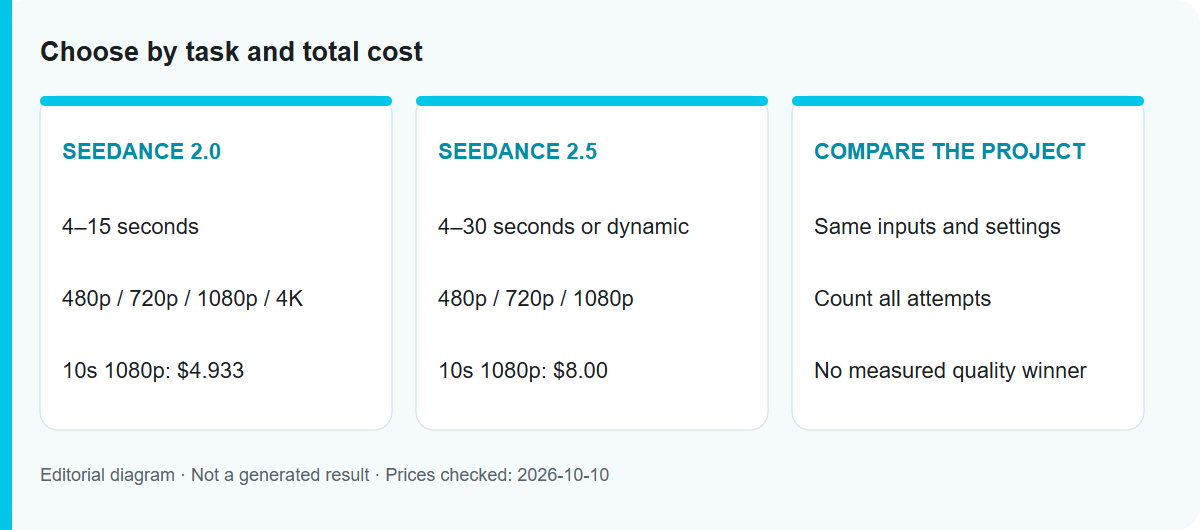
Choose by task and total cost: Editorial workflow diagram, not a tested model output
What both versions support
Seedance 2.0 and Seedance 2.5 both support text-to-video, first-and-last-frame and multimodal reference workflows. Both can combine visual and audio requirements and provide common horizontal and vertical formats.
Shared input types do not imply identical results. A larger reference allowance also does not mean that adding every available asset improves a request.
Specifications that change the decision
The current 2.0 route supports 4–15 seconds and 480p, 720p, 1080p and 4K output. The 2.5 route supports 4–30 seconds, including dynamic duration, with 480p, 720p and 1080p currently listed. A higher version number does not establish 4K support.
Reference limits expand from 9 images, 3 videos and 3 audio clips in 2.0 to 30 images, 10 videos and 10 audio clips in 2.5. Additional duration and validation rules still apply. Check the 2.0 Docs and 2.5 Docs for your input combination.
Compare matching cost conditions
The rates below were checked on October 10, 2026 using the public search on APIXO Pricing, and agree with both model pages. Recheck current rates before submitting.
API usage rates; Studio monthly credits are separate.
For requests without video references, the output-second rates are:
480p: 2.0 costs $0.0933; 2.5 costs $0.14.
720p: 2.0 costs $0.20; 2.5 costs $0.315.
1080p: 2.0 costs $0.4933; 2.5 costs $0.80.
A hypothetical 10-second, 1080p request without a video reference is $4.933 for 2.0 and $8.00 for 2.5, about 62% higher for this request. That calculation does not establish a 62% difference in usable-output cost.
With a video reference, use the relevant video-reference rate and add actual input-video seconds to output seconds. For a 5-second reference and 10-second output at 1080p, the calculated totals are $4.5705 for 2.0 and $7.50 for 2.5. Do not compare a reference-mode starting price with a different mode's full price.
Evaluate output separately from specifications
The official Seedance 2.5 introduction describes improvements in longer narratives, multimodal referencing and timestamp control. Official examples do not establish your project's success rate.
For a direct comparison, keep assets, duration, resolution, framing and audio requirements the same. Inspect subject appearance, action completion, shot continuity and sound, retaining all attempts.
Run a separate capability test for a 20-second scene or a request needing more than 9 images. That tests a specification advantage; it is a different question from quality at matching settings.
Use two questions to choose a version
First ask whether the route meets the delivery specification. Then ask whether the upgrade reduces actual rework. Published specifications answer the first question; your own outputs must answer the second.
Project requirement: At most 15 seconds, few references, tight budget · Initial choice: Compare 2.0 and 2.5 under identical settings · Reason: The listed 2.0 rates are lower; acceptance still needs testing
Project requirement: One generated segment longer than 20 seconds · Initial choice: 2.5 · Reason: The current 2.0 route stops at 15 seconds
Project requirement: Direct 4K delivery · Initial choice: 2.0 · Reason: Only 2.0 currently lists 4K among these two routes
Project requirement: More than 9 images or 3 videos/audio files · Initial choice: 2.5 · Reason: It has higher reference limits; duration and conflicts still matter
Project requirement: Review several previews before committing to HD · Initial choice: 2.5 Draft/Final · Reason: Compare the complete shortlist workflow against direct HD generation
Consider hypothetical generation spend for ten-second 1080p clips without video references. Three 2.0 attempts cost about $14.799; one accepted 2.5 attempt costs $8. Reverse the acceptance pattern and one 2.0 attempt costs $4.933 against $16 for two 2.5 attempts. These scenarios demonstrate the effect of retries; they do not establish which model is cheaper in practice.
For every output, record subject accuracy, action completion, transitions, audio, accepted seconds and rejection reasons. Keep identical-setting comparisons separate from tasks that exceed the older route's limits. Generating a longer segment does not establish superior quality for the same short shot.
Where Draft changes the workflow
Seedance 2.5 can produce 480p Drafts and generate a 1080p Final from a selected Draft. This can help when screening several directions. Final is another generation inheriting Draft conditions, so inspect its details again; it is not ordinary upscaling or an identical-output guarantee.
The existing Draft-to-Final guide covers the workflow. This comparison focuses on version selection.
Choose by the brief
Use 2.0 as a baseline for short shots with modest reference needs. Evaluate 2.5 for longer single outputs, larger asset sets and candidate screening. Check current 4K requirements explicitly.
Enter through APIXO, define what makes a result usable and reserve a test budget. The video budget guide explains how to include retries and editing in the comparison.
Build with APIXO
Explore image, video, and audio models in one place.