An accepted legacy Suno request does not establish that the legacy model is still running. APIXO maps supported old mode names to the V6 family. Existing integrations should update version labels, make the requested mode explicit and verify the input and output contracts.
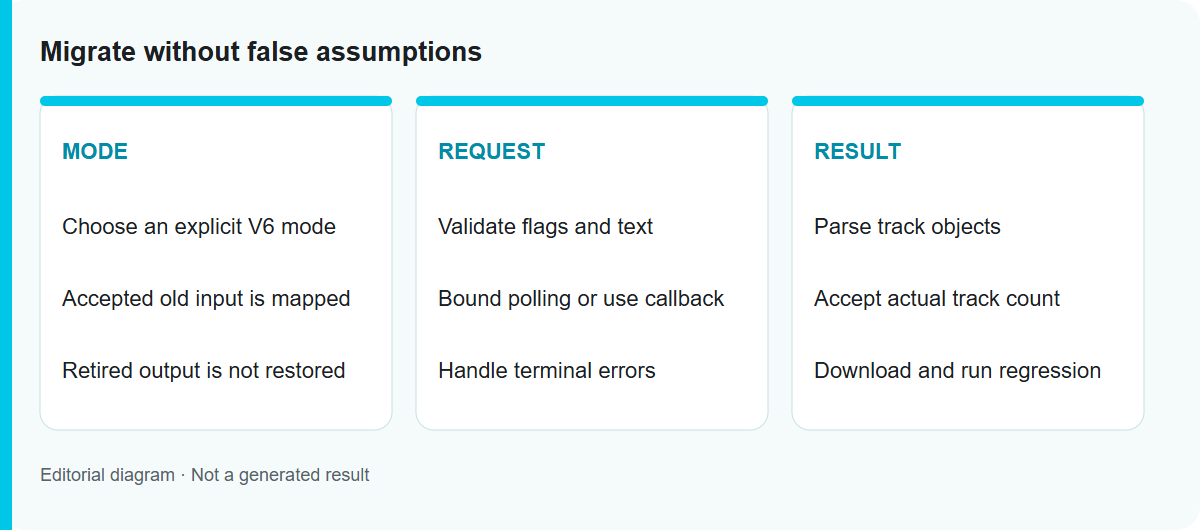
Migrate without false assumptions: Editorial workflow diagram, not a tested model output
Separate model changes from interface changes
The Suno V6 announcement describes the V6, Wild and Mini family and its creative improvements. It does not prove that every field in APIXO's current contract was introduced with V6.
APIXO still uses asynchronous task submission and result retrieval. A migration may preserve most calling code while requiring mode selection, validation and audio regression checks. Request compatibility and creative-output compatibility are different tests.
Other supported V3, V4 and V5 modes or aliases map to V6.
New requests should use V6, V6_MINI or V6_WILD explicitly. Update configuration, user-facing selectors and task records. Two historical experiment labels may now map to one model, so they no longer establish a comparison between distinct versions.
Validate the current request
The mode belongs in input.mode. customMode distinguishes concept-description creation from custom lyrics, and instrumental specifies the instrumental requirement.
This example request body has not been submitted:
{
  "request_type": "async",
  "input": {
    "mode": "V6",
    "prompt": "A restrained instrumental track for a night-city video",
    "customMode": false,
    "instrumental": true
  }
}
Use the current APIXO authentication and Suno endpoints, not parameter names copied from another platform. The documented routes are POST /generateTask/suno and GET /statusTask/suno.
The description limit is currently 500 characters and the custom-text limit is 5,000. customMode=true also requires style and title. These are present contract constraints; this guide does not label them as new V6 changes.
Parse track objects
The successful resultJson is a JSON string. Its parsed resultUrls contains track objects with fields including audio_url and image_url, rather than a flat array of URL strings.
This is a parsing example, not a complete SDK. Process the actual array rather than assuming exactly two tracks or treating two tracks as two tasks. Validate malformed responses and download failures in your application.
Regress against business requirements
Use representative historical briefs: custom lyrics, instrumentals, defined styles and important vocal cases. Record the explicit mode, complete input, task state, returned track count and actual cost.
Audio need not match an old waveform sample for sample. Useful acceptance criteria include intelligible required lyrics, the presence or absence of vocals, suitable structure and successful playback. Success rate, latency and usable-track rate require recorded calls; no paid generation was performed for this guide.
Validate compatibility, migration and capability separately
Acceptance of a legacy request establishes input compatibility, not continued access to the retired model. Current Docs map V3.5/V3_5 and V4.5 All/V4_5ALL to V6_MINI; other retired V3/V4/V5 modes or aliases map to V6. New integrations should explicitly select V6, V6_MINI or V6_WILD.
Layer: Request · Minimum check: Explicit mode, custom/instrumental flags and text limits · Response to a problem: Validate before submission; do not endlessly retry invalid parameters
Layer: Terminal state · Minimum check: Separate processing, success, failure and timeout paths · Response to a problem: Bound polling and deduplicate callbacks by task
Layer: Result · Minimum check: Parseable resultJson and an actual resultUrls object array · Response to a problem: Do not hard-code two tracks or treat objects as URL strings
Layer: Download · Minimum check: Save and play every accepted audio_url · Response to a problem: Archive promptly instead of depending on the default 15-day URL retention
Layer: Business · Minimum check: Essential lyrics, instrumental requirement, structure and cost · Response to a problem: Listen and record acceptance reasons; do not demand reproduction of old audio
Suno describes stronger understanding of musical language and additional creation/editing workflows. Which of those workflows APIXO exposes must be established from the current route; changing mode does not automatically provide the entire official editor. Log the mode submitted by your application alongside the documented mapping so an old UI label is not reported as the generation model. Official V6 introduction, APIXO contract
Update version and price descriptions
APIXO Pricing, checked on October 10, 2026, lists $0.18 per generation task, with the model page applying the same rate across the three V6 modes. Mini's official efficiency positioning does not establish a cheaper APIXO task price.
API usage rates; Studio monthly credits are separate.
Keep user-facing labels consistent with the current V6 model family. Migrate in order: mode mapping, explicit input.mode, input validation, result parsing and a small business regression sample.
Build with APIXO
Explore image, video, and audio models in one place.